
Memories through Touch – project update 1
Welcome to the first of a series of blogs documenting Alzheimer Scotland Student Research Programme student Lyes Oussaiden’s journey throughout the ‘Memories through Touch’ project.
Hello everyone!
My name is Lyes Oussaiden. I’m an MbR student at Abertay University currently being supervised by Dr. Andrew Reid, Dr. William Kavanagh, and Dr. Dayna Galloway for ‘Memories through Touch: Designing Multisensory Experiences for People Living with Dementia.’ Joining the supervision team is Dr. Amy Rogers from Dundee University, the project’s clinical advisor.
You might have a few questions about what this project is and how it’s coming along. Hopefully this blog will help to detail what I know and where I am with it so far.
Football memories
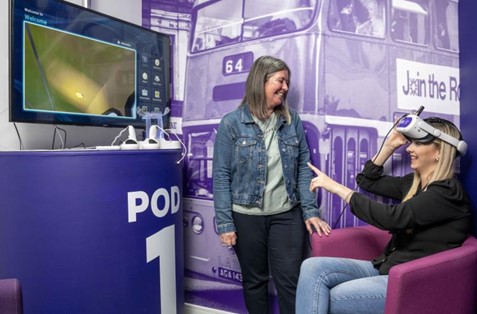
Photo from Alzheimer Scotland blog post on “Virtual reality experience could be a game changer for football fans with dementia”. (2024)
Back in 2023, Dr. William Kavanagh reached out to me about a research project he was working on with a team of researchers at Abertay in collaboration with Alzheimer Scotland. Fresh out of university, I was the producer of ‘crab.Bit’, a small game development team focused on creating works for exhibition spaces. Via the ‘Football Memories’ research proposal, crab.Bit was approached to develop a virtual reality (VR) experience for people living with dementia who held interests in Scottish football. While I wasn’t a researcher, the responses we received whilst developing the project with people living with dementia was, for me, very profound and incredibly impactful. This motivated me to maintain an interest in dementia related studies, and academia overall. crab.Bit eventually fizzled out, but I remained at the university first as a teaching fellow for six months, and then as a lecturer for a year teaching game design to undergraduate students. During this position, William brought up the SDRC’s proposal and discussed that it might be something that could be a great fit given my prior work.
Memories through touch
With ‘Memories through Touch’ I aim to explore gaps left by group reminiscence and understand how technology could play a role into enhancing tactile aspects of reminiscence. While traditional computer entertainment projects are impressive and highly impactful, it’s expensive to commission bespoke software that is flexible enough to cater for individualised needs.
Serving as a spiritual successor to Football Memories, the earliest idea of the proposal was the notion of using technology to somehow enhance or fulfil a needs gap with traditional reminiscence therapy. In addition to exploring tactile experiences, I am wanting to better understand and design for agency and social experiences with reminiscence experiences in home settings. Basing developments on first-hand accounts and direct input from people living with dementia, a prototype toolkit will be produced to address issues or gaps left by traditional reminiscence therapy.
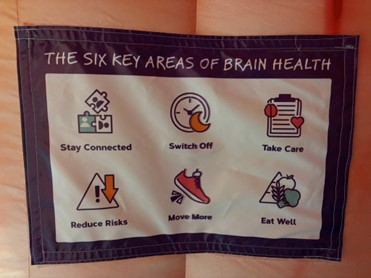
‘The Six Key Areas of Brain Health’ as stuck onto the walls of the big brain showcased at the Alzheimer Scotland Conference 2025.
My background is in video game design and production, but this work isn’t so prescriptive. Despite my comparatively short time in academia, I am heavily inspired by my peers in the Faculty of Design, Informatics and Business here at Abertay. I am most comfortable researching qualitatively. Regardless of how the prototype toolkit appears in presentation or behaves in function, the main throughline with the to work in line with Alzheimer Scotland’s penultimate aim of ‘Care’ in ‘Prevent, Care, Cure’: the research is angled towards improving the quality of life for people living with dementia.
I want to make it abundantly clear that I have no motives other than to produce something meaningful with and for people living with dementia. I have little idea for what the practical toolkit will look like, nor do I want to be heavy-handed with my influence on this. During a recent Active Voice meeting, I brought up that I had identified some pre-existing research exploring playful reminiscence through a largely observational approach to designing and testing. I am highly disapproving of this. No doubt, with this project, there’ll be some elements of observational testing, but it’s disheartening to see that people living with dementia have been spoken ‘on behalf of’ in previous research projects.
I am always open to learning new experiences and developing nuance with regards to approaches to research, but I’m also critical of designed experiences that haven’t at least considered co-design. In games academia, we understand that interactive processes – whether digital or not – are highly influential and persuasive. We teach students the importance of understanding the values that design projects can project onto the player of a game or the end-user of an experience. We talk of ‘subject matter experts’ and co-design processes when it comes to developing games and experiences, especially within those that aren’t created purely for entertainment purposes, or projects that tackle serious themes. Using lessons learned from my past experiences, alongside research conducted previously by the MinD project, I want to help facilitate co-design sessions – where people living with dementia are actively contributing to the development of the final project – throughout my research. Such sessions might be as easy going as a conversation around lived experiences, or could be more expansive, with full sessions of creative exploration and knowledge exchange.
Where are we now?
After the incredibly eye-opening experience I had at the Alzheimer Scotland Annual Conference I attended just shortly before the start of my research, I’ve settled into Abertay’s graduate school very well! I’m starting to make amazing friends and have reconnected with lecturers I used to work alongside.
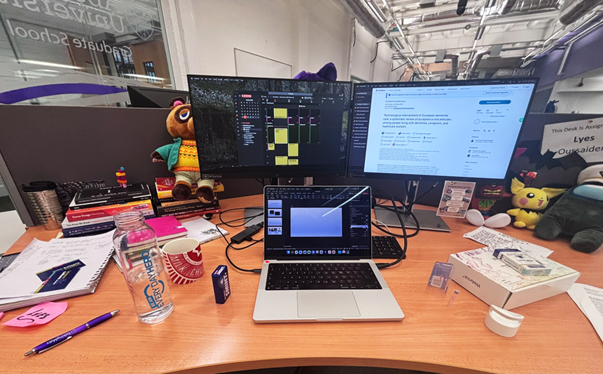
My assigned desk at the Abertay University Graduate School.
It has certainly been a busy and hectic month, but it has also been incredibly rewarding and exciting. So far, I have been afforded the opportunity to dig deep and explore avenues of development. Before the first co-design session, I have a series of practical goals (alongside administrative and desk research tasks) my supervisors and I would like to achieve. I’ve been using an analogy of ‘Lego bricks’ to describe this stage of development. Essentially, I am in the process of developing a series of tools that co-designers living with dementia can put together with little to no technical experience. Regardless of how these ‘Lego bricks’ figuratively slot together, the goal is to provide context for my initial direction, highlighting what should be possible and opening a dialogue to challenge this initial direction.
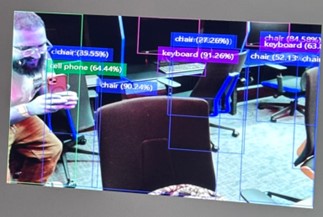
Live camera feed utilising the YOLO11 object tracking (detection) tool, all running within Godot, an interactive media / game development software.
Right now, practical developments consist of a means of using a camera to track objects on a computer, and plugging this into software traditionally used for the development of computer games. We have confirmed that, for the progress we’re at right now, this code should work across mobile phones, tablets, and PC and Mac computers. The performance of this is another question, but the focus is on getting something working and adjusting requirements only where necessary. I’m working within the limitations that the end-user will only have access to a computer, a television screen, a camera, and reminiscence artefacts. This helps keep the project focused and on track. On the same token, all of this is subject to change the more I co-design and research.
What’s next?
A fair amount of administrative work is needed to ensure I have the correct documents to perform co-design and data collection. However, I am terribly excited to begin co-designing soon. I cannot share many details of this at the moment, but participants will not need any experience with technology or design. While documents are in the process of being approved, I’ll be tackling different angles of the development process to make more ‘Lego bricks’.
Thank you very much for reading through this first blog. Make sure to check back next month for another update! Keep an ear out and watch this space.
All the best,
-Lyes Oussaiden.